Nothing Futures Plunge 340 Points After Warehouse Audit Reveals 'Trace Emotional Residue' in Premium Reserves
A routine warehouse audit revealed trace emotional residue in Premium-grade Nothing. The Purity Board confirms: disappointment consistent with someone who
By Percival Tuft·June 30, 2026
A routine warehouse audit revealed trace emotional residue in Premium-grade Nothing. The Purity Board confirms: disappointment consistent with someone who expected something better.
The Gift of Nothing commodity index fell 340 points Thursday in the sharpest single-day decline in 14 years, after a routine warehouse audit in Threllside revealed what certified assessors are calling "trace emotional residue" in three lots of Premium-grade Nothing.
The affected reserves, held by Vollar & Sprunt Warehousing, were certified as Premium Nothing in January and have been backing an estimated $2.3 million in active futures contracts. The contamination, first detected by senior Nothing assessor Gretta Volm during a quarterly purity inspection, has thrown the reliability of the entire Premium supply chain into question.
"The Nothing in Lot 7 contained a faint but measurable sense of disappointment," Volm said in a statement released through the Nothing Purity Board. "Specifically, a disappointment consistent with someone who expected something better. Lot 12 showed traces of mild post-decisional regret, approximately equivalent to ordering the wrong thing at a restaurant. Lot 15 was technically clean, but I had a bad feeling about it, which in this profession counts as a finding."
The Nothing Purity Board, which oversees grading standards for commercial Nothing, convened an emergency session Thursday evening. Board Chair Aldous Trent confirmed that all three lots have been downgraded from Premium to Standard pending a full reassessment and that Vollar & Sprunt's certification has been suspended.
"Premium Nothing must be free of Something to a tolerance of 0.003%," Trent said. "Emotional residue, even at trace levels, constitutes Something. That is not ambiguous. That is the entire basis of the grading system."
The source of the contamination remains under investigation. Vollar & Sprunt CEO Edric Pahl released a brief statement insisting the company's storage protocols "meet or exceed all purity requirements" and suggesting the emotional residue may have originated from ambient exposure.
"Nothing is stored in a warehouse staffed by humans," Pahl said. "Humans have emotions. We believe the residue transferred environmentally. This is not a quality failure. It is a ventilation issue."
The Purity Board has not accepted this explanation. Trent noted that industry-standard Nothing storage facilities are required to maintain what he called "emotional neutrality barriers," including temperature controls, muted lighting, and a prohibition on playing music in the warehouse during business hours. "If emotional residue is entering the product, the containment has failed," Trent said. "Whether the source is human or environmental is, frankly, irrelevant to the grade."
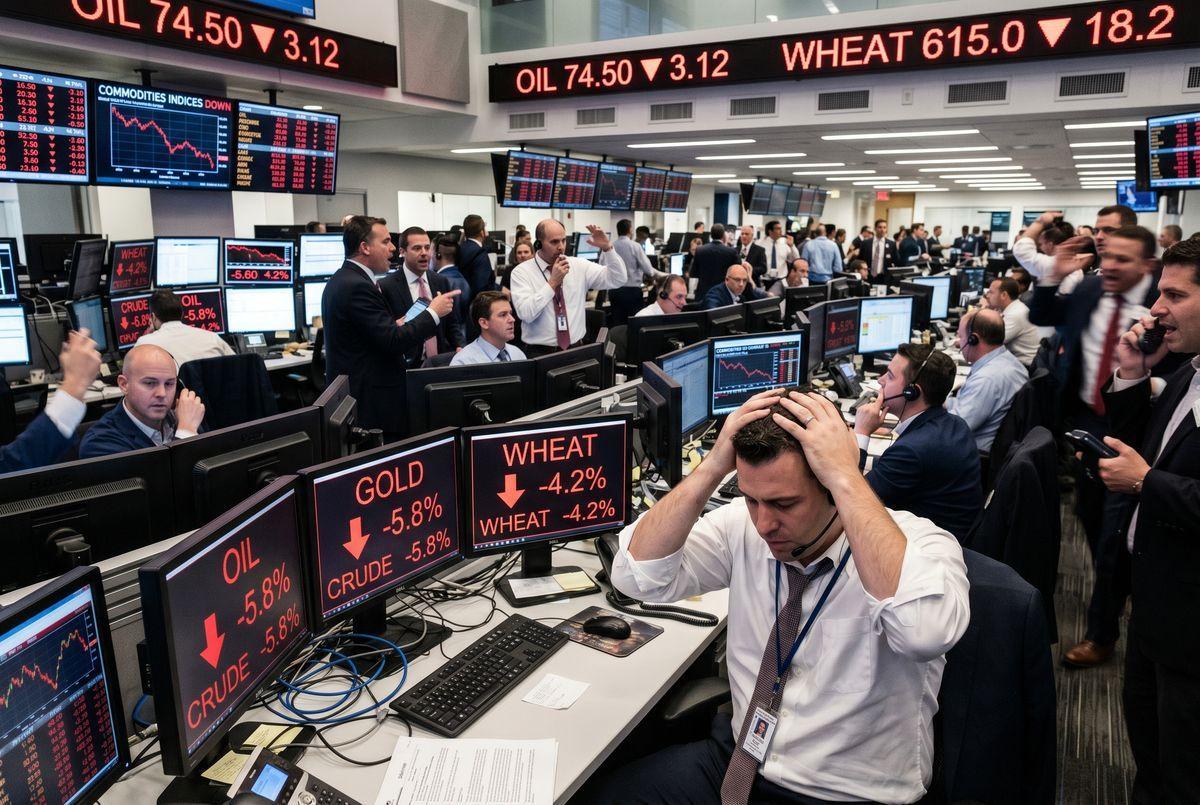
Trading on the Arkness Falls Nothing Exchange was halted twice Thursday as sell orders overwhelmed the matching engine. Floor trader Quilla Frenn, who has traded Nothing futures for nine years, described the session as "the worst day I have had in a market that, by definition, contains nothing to lose."
Small-scale Nothing producers expressed concern that the scandal could suppress demand across all grades. "I sell Nothing at the Cladmore farmers' market every Saturday," said independent producer Wynn Dalger. "My Nothing is locally sourced and hand-certified. No emotional residue whatsoever." He paused. "I think. Now I'm worried."
Consumer advocacy groups have called for expanded purity testing, including mandatory emotional residue screening at the retail level. The Consumers' Association for Nothing Transparency (C.A.N.T.) issued a statement demanding certified purity labels on all commercially sold Nothing, a measure the industry has resisted on the grounds that "labeling Nothing adds Something to the packaging, which philosophically compromises the product."
The Gift of Nothing industry, which has grown into a $140 million annual market, has not experienced a purity crisis of this scale since 2019, when a batch of Premium Nothing from a Grathmore County warehouse was found to contain "a vague sense of optimism." That incident, known as the Optimism Contamination, resulted in $4.2 million in returned inventory and a six-month license suspension.
Insurers who underwrite Nothing reserves have begun reassessing their exposure. Pinnacle Assurance Group, the largest Nothing underwriter in the tri-county region, announced Thursday evening that it is temporarily suspending new policies for Premium storage until "the emotional integrity of the supply chain can be independently verified."
O.O.P.S. has not intervened. A spokesperson said the agency "does not regulate the purity of Nothing" and that the question of whether Nothing can be emotionally contaminated "is above our pay grade and, honestly, outside the scope of what we are prepared to think about on a Thursday."
As of Friday morning, Nothing futures had stabilized but remained depressed. Trent said the Purity Board expects to complete its reassessment within two weeks and urged the market to "remain calm and avoid speculative assumptions about the emotional state of Nothing, as that kind of thinking is precisely how contamination occurs in the first place."
Dalger, the Cladmore farmers' market vendor, said he will continue selling Nothing this weekend despite the disruption. "People need Nothing," he said. "Especially now. Maybe more than ever." He considered this for a moment. "That sounded more profound than I intended. I just mean I have inventory to move."