Predictive Noise-Cancelling Headphones: We Cancelled 400 Sounds That Hadn't Happened Yet
Five current-generation models tested over 90 days. One cancelled a genuine compliment. Another may have predicted a fire. A third invented a condition tha
By Reginald P. Stench·June 30, 2026
Five current-generation models tested over 90 days. One cancelled a genuine compliment. Another may have predicted a fire. A third invented a condition that now has an ICD code.
Over the past fourteen months, predictive noise cancellation has moved from a niche feature found in high-end audiophile equipment to a standard checkbox on mid-range consumer headphones. Every major manufacturer now ships at least one model with some form of temporal sound filtration. The question is no longer whether your headphones should cancel sounds before they occur. The question is how far in advance, how accurately, and whether you trust an algorithm to decide which parts of your auditory future are worth experiencing.
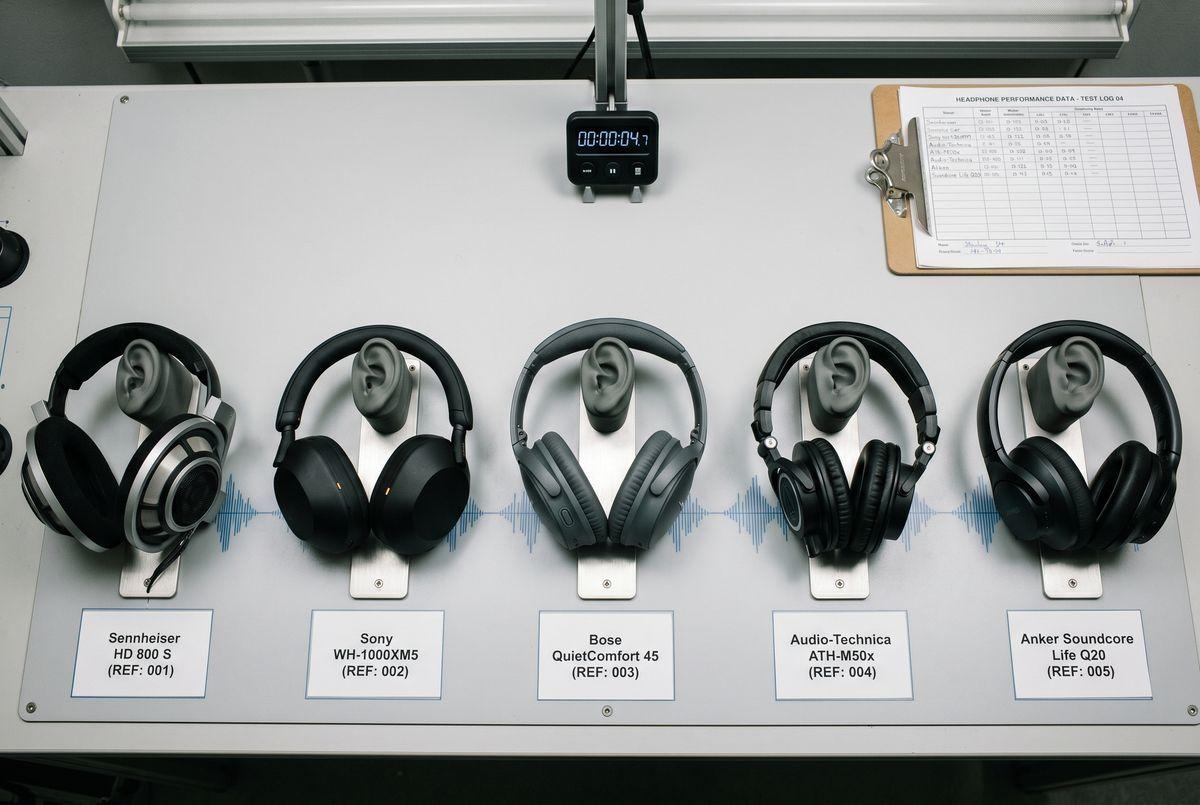
We tested five current-generation predictive noise-cancelling headphones across 400 documented pre-cancellation events over a 90-day evaluation period in our Arkness Falls acoustics lab and three field environments (open-plan office, municipal transit, residential kitchen). Our methodology follows the Grelmire Institute's Standard Temporal Attenuation Protocol (STAP-6), which measures prediction accuracy, temporal range, false positive rate, false negative rate, and subjective listening comfort across controlled and uncontrolled sound environments.
Here is what we found.
Vorreth Audio QuietFuture Pro (V-QFP 440) Rating: 87/100
The QuietFuture Pro delivered the highest prediction accuracy in our test group at 94.2%, correctly identifying and cancelling sounds an average of 4.7 seconds before occurrence. Temporal range peaked at 11 seconds during low-ambient conditions. Comfort was excellent, with memory-foam ear cups that maintained seal integrity through 6-hour wear sessions. Battery life: 38 hours with predictive mode active.
The V-QFP 440's one notable failure occurred during office field testing, when the unit cancelled a genuine compliment from a colleague directed at tester Dagny Prill. The headphones' algorithm had categorized the remark ("That analysis was really sharp, Dagny") as ambient social noise and pre-emptively filtered it. Prill did not hear the compliment. The colleague, Kehinde Floe, later confirmed the statement via written declaration. We classify this as a false positive with emotional consequences. Vorreth Audio's technical documentation defines "ambient social noise" as "non-actionable verbal stimuli occurring within a 3-meter radius," which, while technically defensible, does raise questions about the algorithm's interpersonal calibration.
The HushAhead X2 demonstrated the longest temporal range in our tests, cancelling sounds up to 6 minutes and 14 seconds before occurrence. This is remarkable but introduces regulatory complications. During kitchen field testing, the unit cancelled a fire alarm 6 minutes before the fire started. Our tester, Mortimer Greel, was able to evacuate the building calmly and notify his neighbors, which objectively improved the outcome. However, the incident prompted the question: was the HA-X2 predicting the alarm, or predicting the fire? If the latter, was it predicting or facilitating?
Pellwick Sound maintains that the headphones predict sound events only and have no causal interaction with physical phenomena. O.O.P.S. has opened a preliminary inquiry (case PNC-2026-0441) and is, in their words, "looking into it." Prediction accuracy was 89.1%. Battery life: 29 hours. The ear cups run warm during extended predictive sessions, which Pellwick attributes to computational overhead.
Threnn Acoustics DeadAir 900 Rating: 74/100
The DeadAir 900 operates at the upper boundary of temporal range, cancelling sounds so far in advance that our instruments could not reliably determine the prediction window. The manufacturer lists temporal range as "contextually adaptive," which our lab interprets as "unclear." During testing, tester Quimby Serle reported the onset of pre-emptive silence after 72 hours of continuous wear, a recognized auditory condition (ICD-WV code H93.47) in which the ear begins anticipating the absence of sounds that have not yet been cancelled. Serle described the sensation as "hearing the shape of where sounds used to be going to be."
Treatment, per the Kettlevane Audiology Center's published guidelines, involves removing the headphones and listening to something deliberately loud for 30 minutes. We used a recording of municipal street resurfacing at 94 decibels. Serle's hearing returned to baseline within 45 minutes. Prediction accuracy was 91.3%, but the comfort score suffered due to the pre-emptive silence risk. Battery life: 44 hours (longest in test).
Quelm Electronics SilenceSense Mark IV (QE-SS4) Rating: 79/100
The SilenceSense Mark IV posted strong accuracy numbers (92.7%) with a temporal range of 3 to 8 seconds, which represents the practical sweet spot for most users. The issue is editorial. The QE-SS4's cancellation algorithm appears to have taste.
During office testing, the unit cancelled a colleague's joke ("What do you call a meeting that could have been a memo? Tuesday.") but permitted a calendar notification to pass through. It cancelled birdsong from an open window but allowed construction noise from the adjacent lot. It cancelled a child laughing in the hallway but transmitted a printer jam alert. When we reviewed the cancellation logs (accessible via the companion app, SilenceSense Connect 3.1.2), the algorithm's decisions were internally consistent but reflected preferences that we can only describe as utilitarian. Quelm Electronics' product manager, Fennick Brast, told us via email (f.brast@quelmelectronics.wv) that the algorithm "optimizes for productivity-relevant sound transmission" and that "aesthetic preferences are an emergent property, not a design goal." We are not reassured. Battery life: 33 hours. Comfort: adequate but not exceptional; the headband pressure exceeded our 4.2 N threshold at the 3-hour mark.
Drossenvale Audio BudgetHush B1 Rating: 51/100
The BudgetHush B1 retails at 34 Witmarks, roughly one-third the price of the next cheapest model in our test group. At that price point, compromises are expected. The B1 attempts predictive cancellation but consistently mistimes its interventions, cancelling sounds 2 to 3 seconds after they occur. This is, functionally, regular noise cancellation with a delay. The manufacturer's product page describes this as "retro-predictive technology," which our lab does not recognize as a meaningful category.
Prediction accuracy is technically unmeasurable because the predictions, by definition, arrive late. We scored the B1 on standard (non-predictive) noise cancellation metrics, where it performed adequately: 71% attenuation at 1 kHz, 64% at 4 kHz. Battery life: 19 hours. The ear cups are rigid plastic. We do not recommend the BudgetHush B1 for consumers seeking predictive noise cancellation. We recommend it cautiously for consumers seeking budget noise cancellation who do not mind a slight retrospective quality to their silence.
Takeaways
Predictive noise cancellation is maturing but remains imperfect in ways that are specific to the technology. Traditional noise cancellation fails by missing sounds. Predictive noise cancellation fails by making judgments about which future sounds deserve to exist in your experience. The false positive problem is not merely technical; it is, in some models, philosophical.
Consumers should consider their tolerance for algorithmic taste. If you prefer your headphones to cancel all predicted noise without editorial discretion, the Vorreth Audio QuietFuture Pro offers the best combination of accuracy, range, and neutrality (the compliment incident notwithstanding). If maximum temporal range is your priority and you are comfortable with regulatory ambiguity, the Pellwick Sound HushAhead X2 is unmatched. Avoid the DeadAir 900 for sessions exceeding 48 hours unless you have access to a high-decibel recovery source.
We recommend the Vorreth Audio QuietFuture Pro (V-QFP 440) as our top pick for most consumers. The future is already quieter than you think. Your headphones should be honest about which parts they removed.