Suppression Panels Rated: Which Greylin-Scale Models Actually Contain What They Claim?
We tested six commercially available suppression panels at their rated Greylin levels under controlled anomaly conditions. Only two performed at or above t
By Reginald P. Stench·June 30, 2026
We tested six commercially available suppression panels at their rated Greylin levels under controlled anomaly conditions. Only two performed at or above their certification. One panel's rating was entirely fictional.
If you own property in a dimension with documented spatial instability (and if you are reading this, you do), suppression panels are not optional. They are the difference between a kitchen that stays where you left it and a kitchen that drifts fourteen inches to the left every time the barometric anomaly index exceeds 3.0. They are also, based on our testing, a product category where the gap between what the label promises and what the panel delivers is wide enough to lose a credenza through.
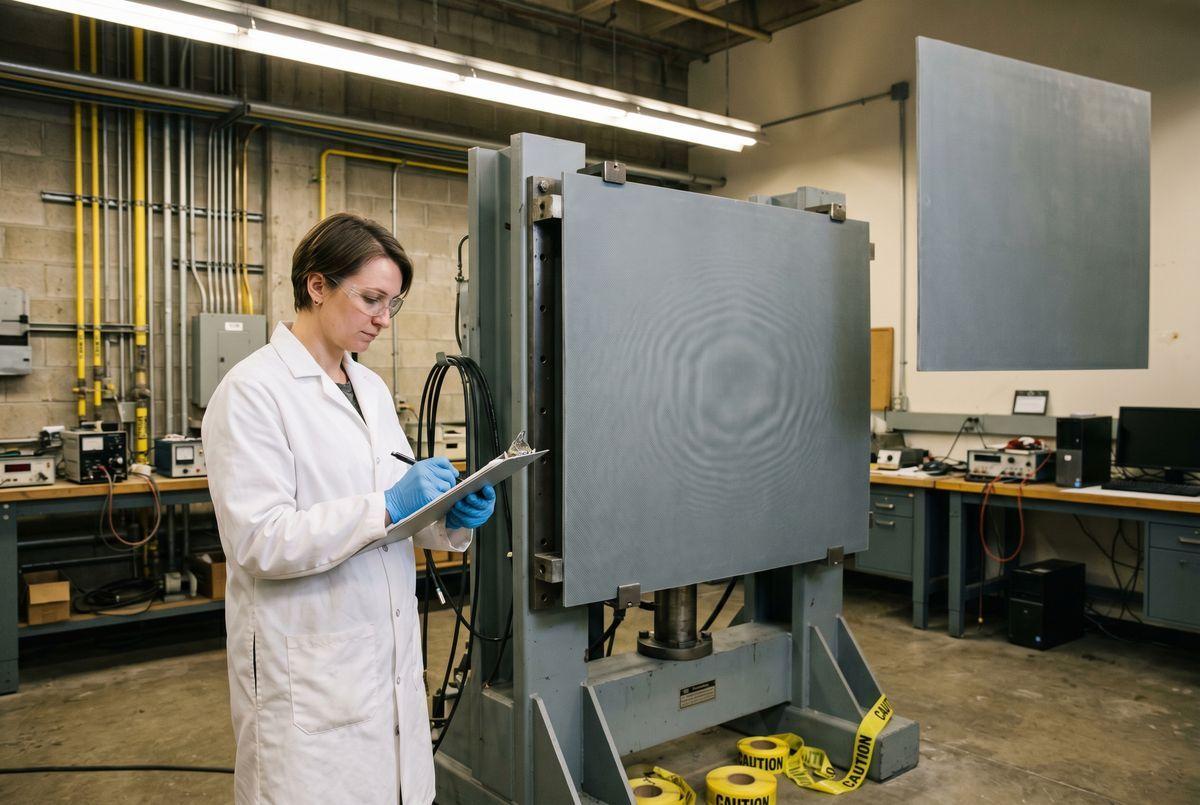
We tested six commercially available suppression panel models at their rated Greylin levels under controlled anomaly conditions at the Pellwick Applied Containment Laboratory over a nine-week period. The Greylin scale, developed in 1987 by Dr. Elspeth Greylin at the Kettlevane Institute of Spatial Integrity, remains the industry standard for rating suppression panel containment capacity. Its five classes are straightforward: Class 1 addresses mild spatial shimmer, the kind barely perceptible to residents but known to upset pets and recalibrate kitchen timers. Class 2 covers intermittent phase drift, where objects may temporarily occupy two positions. Class 3 denotes sustained spatial distortion with furniture displacement possible. Class 4 indicates structural concern, requiring a building permit in all 47 participating jurisdictions. Class 5 is theoretical only, untested, and the subject of an ongoing grant dispute between Kettlevane and the Bureau of Inflatable Consumer Structures, which maintains that "theoretical" is not a rating but "an admission."
All panels were installed per manufacturer specifications by licensed suppression technicians. Anomalies were generated using the laboratory's Trellis-Vane induction array, calibrated to the Pellwick Standard Distortion Protocol (PSDP-4). Each panel was subjected to escalating Greylin-class conditions until it failed or the testing team requested a break for reasons that will become clear.
METHODOLOGY
Each panel was rated on six metrics: containment efficacy at its rated Greylin level, certification accuracy (does the label match observed performance?), installation difficulty, failure behavior (graceful versus dramatic), noise generation, and cost-per-Greylin-unit. Panels were scored on a 100-point composite. Three independent technicians verified all readings. One of them has since relocated, though not voluntarily.
RESULTS
Vorreth Industrial VP-3100 (Rated Class 3) -- Score: 87/100 The VP-3100 delivered clean containment at Class 3 with minimal spatial bleed. Installation was straightforward, requiring only a standard phase wrench and approximately forty minutes of your afternoon. At Class 4, it failed gracefully: the anomaly dissipated across a twelve-minute window with no furniture displacement beyond a slight rotation of the testing room's coat rack. At $14.20 per Greylin unit, it offers the best value in the field. "It does what the box says," noted lead technician Margil Drent. "In this category, that qualifies as exceptional."
Quelm Dynamics QD-440X (Rated Class 4) -- Score: 79/100 The QD-440X held at Class 3 without incident. At its rated Class 4, containment held but the panel produced a low, continuous hum that the testing team described as "deeply personal." Each team member reported hearing a different frequency. Technician Drent described hers as "the sound my mother makes when she's disappointed but won't say why." Technician Oleg Parsh reported "a pitch that somehow reminded me of every email I've ever not replied to." The manufacturer, Quelm Dynamics, confirmed the hum is a known byproduct of high-Greylin suppression and stated it "typically resolves within three to seven days, or when the listener addresses whatever the frequency is about." Containment was otherwise excellent. Installation required two technicians and a mood nobody could explain.
Threnn-Barlow SuppressMax Elite (Rated Class 4) -- Score: 72/100 The SuppressMax Elite is the premium entry in our test. It performed flawlessly at every Greylin class we threw at it, including a brief, unauthorized exposure to Class 4.6 that the lab director has asked us not to discuss in detail. Containment was total. Failure behavior was nonexistent because the panel did not fail. The problem is cost: at $61.40 per Greylin unit, the SuppressMax Elite costs more than the median assessed value of a residential unit in Drossenvale. "It is an extraordinary product," said Drent. "It is also an extraordinary use of money that could be spent on a house."
Grelmire Home Solutions GHS-200 (Rated Class 2) -- Score: 64/100 The GHS-200 is the budget option, priced at $6.80 per Greylin unit, and it performs like one. At Class 1, it contained spatial shimmer adequately. At its rated Class 2, the panel failed within eleven minutes. The anomaly migrated through the panel's eastern seal, traveled down the corridor, and settled in the testing laboratory's break room, where it has remained for six weeks. The break room now exists at a persistent 7-degree spatial offset. Coffee mugs placed on the counter slide to the left. The refrigerator door opens into last Wednesday. Staff have adapted. "We just eat lunch somewhere else," said lab coordinator Fenella Tupp. "It is not ideal, but the vending machine still works if you approach it from the right angle. Literally the right angle. Forty-three degrees."
Kettlevane Precision KP-5 (Rated Class 3) -- Score: 51/100 The KP-5 presented a unique evaluation challenge. During Class 3 testing, the panel contained the anomaly successfully but in the process developed its own anomaly. The panel now exists in two locations simultaneously: its original installation point in Testing Bay 4 and, for reasons the Kettlevane Precision engineering team has described as "not yet fully characterized," a storage closet in the Pellwick cafeteria. Both instances of the panel appear to be functioning. Data from both locations is identical. "We are not prepared to call this a defect," said Kettlevane Precision spokesperson Aldren Voss. "We are calling it a coverage bonus." The company has not updated its marketing materials, but our understanding is that they are considering it.
Mossbank Consolidated MC-1000 (Rated Class 3) -- Score: 34/100 The MC-1000 failed at Class 1. Its rated Class 3 certification, upon investigation, turned out to be aspirational rather than tested. Mossbank Consolidated's quality assurance director, Bertram Flinch, confirmed in a written statement that the Class 3 rating was "based on the product's potential, which we continue to believe in." When pressed on whether the panel had ever been subjected to a Greylin-class anomaly prior to our testing, Flinch responded: "We felt it was important to let the product speak for itself." It spoke. What it said, metrically, was Class 0.7. Flinch's follow-up statement noted that the company "stands behind its product, though at a safe distance." The Pellwick lab has filed a certification complaint with O.O.P.S., which has acknowledged receipt and indicated it will "review the matter in due course," a phrase that, in our experience, means the complaint will be found in eleven months inside a drawer that no longer exists.
TAKEAWAYS
The suppression panel market rewards caution. Certification accuracy varied wildly: only two of our six tested panels performed at or above their rated Greylin class. One panel's rating was entirely fictional. Consumers should request a Certificate of Tested Greylin Performance (CTGP) from any retailer, and should be suspicious of any panel sold without one, particularly at price points that seem too reasonable for the laws of physics they claim to be containing.
RECOMMENDATION
The Vorreth Industrial VP-3100 is our top pick for residential use. It does what it claims, costs what it should, and when it fails, it fails like a responsible appliance: quietly, slowly, and with adequate warning. For commercial or high-risk installations, the Threnn-Barlow SuppressMax Elite is technically without peer, provided you are comfortable spending more on a wall panel than most people spend on the wall.
Consumers on a budget should avoid the Mossbank MC-1000 entirely and consider the Grelmire GHS-200 only for Class 1 applications, accepting that any ambition beyond mild shimmer suppression will result in the anomaly relocating to whichever room you like best.
The Kettlevane KP-5, meanwhile, remains under observation. Both of it.